Enrollment Access
$695
Dashboard access, module tracking, assignment submission, and intermediate feedback through all six modules.
Enroll in CEFCA standards-led credential built around evidence review, rubric controls, and scope transparency. Six modules, a three-part capstone, and a full practice launch kit.
Independent provider · Mapped to ICF/NBEFC standards · No external accreditation claimed · See accreditation status
Curriculum access is free. Pricing applies only to enrollment tracking, human review, and credential operations.
Enrollment Access
$695
Dashboard access, module tracking, assignment submission, and intermediate feedback through all six modules.
Enroll in CEFCCapstone Review
$350
Rubric scoring, written evaluator feedback, resubmission support, and certificate issuance upon passing.
Add Capstone ReviewBest Value
$895
Full path: enrollment access + capstone review + certificate. Save $150 versus buying separately.
Buy the Full PathCapstone resubmission is included at no extra cost. Questions? Start a conversation.
Three components that take you from learning the science to opening a practice.
Self-paced modules covering neuropsychology, assessment, coaching architecture, applied methods, special populations, and professional ethics. All modules are publicly inspectable before you enroll.
The decisive readiness review. You complete an intake simulation, a case study intervention plan, and an original resource. All three parts must pass the published rubric before the credential is issued.
Every certified graduate receives a full toolkit: digital ESQ-R, intake scripts, parent and student interview protocols, intervention worksheets, SOAP note templates, service agreement, and business plan framework.
The CEFC is best suited for three groups. If none of these match, the free curriculum layer is still worth using.
You already work with students and want a structured credential that validates your EF coaching approach for IEP teams and administration.
You want to transition from teaching, counseling, or related work into private EF coaching practice with a clear business launch path.
You already coach but want deeper EF-specific methodology, a capstone that tests real-world application, and a credential to share with referral partners.
Before You Decide
Certification requires successful completion of all six curriculum modules and a three-part capstone practicum that demonstrates coaching readiness.
Before attempting the capstone, candidates must complete all six modules with passing marks on every assignment:
Capstone Snapshot
The capstone is the decisive readiness review. It is a three-part demonstration of competence:
All three components must receive passing rubric scores before certification is conferred.
The CEFC is a competency credential designed to demonstrate readiness for the work below.
Administer the ESQ-R, lead a Goodness of Fit conversation, and synthesize functional impairment data into a coherent client profile — without crossing into diagnostic territory.
Design intervention plans that integrate Barkley's inhibitory model, Brown's cluster framework, and Dawson & Guare's two-tiered approach into a unified, client-specific strategy.
Teach "Get Ready, Do, Done" backward planning, analog time management, cognitive offloading systems, and environmental modification at the point of performance.
Distinguish coaching from therapy, manage the parent/coach/client triangle, and refer appropriately when presenting concerns exceed coaching scope.
Modify strategies for ADHD, ASD, twice-exceptional learners, college students, and adults navigating life transitions — without overgeneralizing.
Apply the Launch Kit deliverables: intake forms, session templates, scope-of-practice statements, and pricing structures for a private or institutional practice.
Each component targets a different dimension of coaching competence — interpersonal skill, analytical rigor, and creative contribution.
Demonstrating interpersonal coaching competence
Submit a structured intake simulation packet (prompt responses + session plan) that demonstrates warm, structured, and effective first-meeting design in an asynchronous format.
Establish a collaborative alliance using active listening, empathic validation, and strengths-based language. The client should feel heard and understood within the first five minutes.
Explain executive function to the client in accessible, jargon-free language. Use the "Air Traffic Control" metaphor or an equivalent analogy to demystify the neuroscience.
Collaboratively identify at least two SMART goals grounded in the client's self-reported EF profile. Demonstrate the "Goodness of Fit" concept from Dawson & Guare.
Grading Criteria
Reviewers evaluate rapport quality, accuracy of EF explanation, collaborative goal-setting technique, appropriate use of assessment data, and overall session structure. A standardized rubric ensures consistency across reviewers.
Demonstrating analytical and theoretical rigor
You will receive a complex case file describing a client with multiple EF challenges across academic, professional, and personal domains. Your task is to produce a detailed intervention plan that demonstrates mastery of all three core models.
Integration Requirement
Plans that rely on only one theoretical model will not pass. The purpose of this assessment is to demonstrate your ability to synthesize Barkley's mechanistic model, Brown's cluster framework, and Dawson & Guare's practical skill taxonomy into a unified, actionable coaching strategy.
Grading Criteria
Reviewers evaluate theoretical grounding (accurate model citations), environmental modification specificity (point-of-performance detail), intervention logic (skill-building matched to deficit profile), fade plan quality (concrete independence milestones), and whether all three core models are integrated rather than siloed.
Contributing to the open-source coaching community
Create one original coaching tool that could be used by any EF coach in practice. This component tests your ability to translate theory into a tangible, reusable resource — and it contributes to the growing open-source library of EF coaching materials.
Grading Criteria
Reviewers evaluate theoretical grounding (tool clearly rooted in at least one EF model), practical utility (immediately usable in a real coaching session without modification), design clarity (professional quality, accessible language), originality (not a reproduction of an existing tool), and documentation quality (the accompanying guide explains intended use and theoretical basis).
These public artifacts show how the credential is reviewed and verified. Everything is inspectable before purchase.
Rubric artifact
The public rubric shows what is being scored and why the capstone is the decisive assessment.
Crosswalk artifact
EFI publishes its ICF and NBEFC-relevant crosswalk so the scope claims are inspectable.
Verification artifact
Issued credentials include a signed verification path so credential status can be checked against EFI records after issuance.
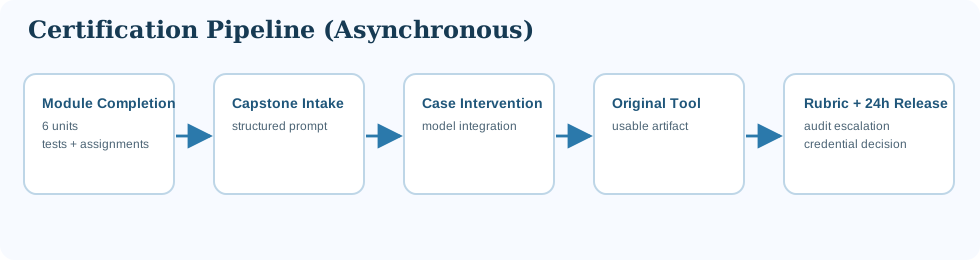
Submissions are scored against a published rubric and released with delayed feedback. High-variance scores are flagged for manual audit review.
Each capstone component is evaluated with a structured rubric focused on conceptual accuracy, intervention quality, ethical scope, and actionability.
Your submission is scored by the rubric engine against weighted criteria. The output includes strengths, improvements, and category-level results.
Feedback is intentionally released after a 24-hour hold window to support controlled quality checks and consistent communications.
Flagged submissions can be manually audited by EFI reviewers before final credential decisions are issued.
Turnaround SLA: most module reviews are released within 2-5 business days (after 24-hour hold), and capstone decisions are typically released within 5-10 business days depending on revision volume.
Why This System?
Rubric-based scoring creates a documented, repeatable standard. Delayed release plus audit escalation reduces inconsistent grading outcomes.
Operational Transparency
EFI does not currently market this as an external accreditation process. It is an internal certification workflow with published standards and verification controls.
Reviewer lead profile currently listed: Jacob Rozansky (Educator).
Every certified graduate has demonstrated competency against the same published rubric and review thresholds.
Below is a public sample of how submissions are distinguished between passing and needs-revision outcomes.
| Domain | Passing Standard | Needs Revision |
|---|---|---|
| Rapport Building | Uses open-ended prompts and reflective listening; validates frustration without judgment. | Relies mostly on advice-giving or closed questions; skips emotional validation to jump to fixing. |
| EF Explanation | Explains EF in accessible, strengths-based language (for example, "air traffic control" framing). | Uses dense jargon without translation; frames EF as personal character failure. |
| Domain | Passing Standard | Needs Revision |
|---|---|---|
| Theoretical Grounding | Interventions explicitly map to Barkley, Brown, Ward, or Dawson/Guare frameworks with rationale. | Uses generic tips (for example, "try harder" / "use a calendar") with no model-based justification. |
| Environmental Modification | Proposes concrete external supports before relying on willpower-based behavior change. | Focuses on internal motivation alone; no practical context/environment redesign. |
This sample is representative. Full scoring includes additional weighted criteria and evidence checks.
Opens with strengths inventory, names one friction pattern, maps to two measurable goals, and closes with first-week execution plan.
Links each intervention to at least one model citation, includes environment redesign first, and includes a clear prompt-fading schedule.
Provides one-page usage protocol, intended client profile, and adaptation notes for school/home/work settings.
Sample Passing Response — Component 1, Rapport Building
"Before we talk about goals, I want to make sure you feel comfortable here. A lot of people I work with have spent years being told they're lazy or not trying hard enough — and that's not what's happening. What we're dealing with is a skill gap, not a character flaw. The brain systems that help with starting tasks, managing time, and staying organized develop differently in some people, and that's what we're going to work with together. Nothing you tell me today is a failure — it's data. Does that framing feel okay to start?"
This excerpt demonstrates strengths-based framing, shame reduction, and collaborative alliance building — three of the five grading criteria for Component 1. Anonymized from a passing submission.
Certification is not just a credential — it is an ongoing commitment to ethical practice, professional growth, and accountability.
Upon passing the capstone, every candidate must sign a digital Ethics Pledge before their certification is conferred. This pledge is a binding commitment to the professional standards that define EF coaching.
I will maintain clear boundaries between coaching and therapy. I will not diagnose, treat, or counsel for mental health conditions. When a client presents with needs beyond my scope, I will refer to an appropriate licensed professional.
I will ground all interventions in peer-reviewed research and the theoretical models taught in this program. I will not promote pseudoscientific approaches or make unsubstantiated claims about coaching outcomes.
I will respect the autonomy and dignity of every client. I will practice strengths-based coaching, reject deficit-only language, and empower clients to develop their own self-regulation capacity rather than fostering dependence on the coach.
I will protect client data with appropriate security measures, obtain informed consent for all assessments and session recordings, and comply with applicable privacy regulations.
I will pursue ongoing professional development, stay current with emerging research in executive function and neuroscience, and contribute to the growth of the EF coaching community.
The EFI Ethics Pledge is designed to align with the professional standards established by major coaching bodies:
Our ethical framework maps to ICF Core Competencies and Code of Ethics to support professional best-practice alignment.
Our scope-of-practice training and ethics curriculum reference NBEFC competency themes.
EFI is an independent training provider and is not currently represented as formally accredited by ICF or NBEFC.
Every certified graduate receives a full collection of professional tools organized into three categories — everything you need to open your practice on day one.
Instruments for understanding your client's EF profile from the very first session.
Ready-to-use coaching resources grounded in the three foundational EF models.
Business templates and documentation systems for running a professional coaching practice.
Join a rigorous, science-based program built to strengthen consistent, documented executive-function coaching practice.