Public File Shows the full syllabus and assignment spine before any grading workflow starts
Review Boundary Reading is open. Scoring, evaluator feedback, and credential decisions are paid review operations.
Best Use Open a module page, the rubric, and the capstone preview in that order if you need proof instead of marketing copy.
Six Modules

Module-by-Module Syllabus

Each module keeps the same review structure: teaching units, key concepts, and a concrete assignment that proves transfer.

1

The intellectual baseline for the certification

Neuropsychology of Self-Regulation

This module requires trainees to synthesize competing yet complementary theories of executive dysfunction to form a cohesive coaching philosophy.

  • Barkley, Brown, and developmental neuropsychology
  • Primary output: temporal horizon analysis
  • Unit 1.1: Evolution & Inhibition (Barkley) — The "Stop, Look, Listen" mechanism and the 4 secondary functions
  • Unit 1.2: The Six Clusters (Brown) — Activation, Focus, Effort, Emotion, Memory, Action, and "Chemical Situational Variability"
  • Unit 1.3: Neuroanatomy 101 — The Prefrontal Cortex, Striatum, Cerebellum, and developmental timelines ("Cool" vs. "Hot" EF)
  • The brain as "Air Traffic Control System" (Harvard metaphor)
  • PFC development timeline from infancy into early adulthood
  • Three core dimensions: Working Memory, Inhibitory Control, Cognitive Flexibility
  • Barkley's evolutionary model: public-to-private internalization
  • "Time Blindness" and temporal horizons
  • The "Extended Phenotype" — EF extending into the physical environment

Assignment 1.1: The "Temporal Horizon" Analysis

Objective: Internalize the concept of "Time Blindness" and its impact on planning.

Write a 1,500-word analysis contrasting the "temporal horizon" of a neurotypical 25-year-old with that of a 25-year-old with significant EF deficits. How does "temporal myopia" affect financial planning, career development, and relationship maintenance? Propose three coaching interventions grounded in the Barkley model.
2

From theory to diagnostics

Assessment Protocols & Intake Strategy

While coaches do not diagnose pathology, they must assess functional impairment to tailor interventions. This module relies heavily on the work of Dawson and Guare.

  • ESQ-R workflow, intake scripting, and interpretation of referenced proprietary measures
  • Primary output: structured client profile report
  • Unit 2.1: The Tools — Using ESQ-R results and understanding BRIEF-2 and Brown-scale reports
  • Unit 2.2: Interpretation — Finding the "story" in the data, identifying discrepancies between self and observer reports
  • Unit 2.3: The Intake Session — Scripting the conversation, establishing the "Collaborative Alliance"
  • The ESQ-R: 25-item self-report survey summarized into five skill areas within the Dawson/Guare framework
  • "Goodness of Fit" concept — when demands exceed skills
  • Strengths-based coaching: share strengths before weaknesses
  • Discrepancy analysis between self-report and observer reports
  • "Point of Performance" audits (digital and physical)
  • BRIEF-2: understanding the BRI, ERI, and CRI within qualified assessment contexts

Assignment 2.1: The Intake Simulation

Objective: Practice data gathering and synthesis.

Locate a volunteer. Administer the Executive Skills Questionnaire. Conduct a 30-minute structured intake interview assessing "Goodness of Fit." Create a 3-4 page "Client Profile Report" including: Executive Profile graph, Narrative Summary, Environmental Analysis, and three SMART goals.

3

Dawson & Guare framework

The Coaching Architecture

This module operationalizes the intervention process, distinguishing EF coaching from tutoring and therapy, framing coaching as "skill acquisition" and "environmental modification."

  • Environmental modification, coaching cycle, ethics
  • Primary output: competency and ethics portfolio
  • Unit 3.1: Environmental Modifications — Changing the where and when to support the who
  • Unit 3.2: Skill Building — Explicit instruction, modeling, and rehearsal strategies
  • Unit 3.3: The Coaching Cycle — Goal setting (SMART), Strategy selection, Action planning, Monitoring
  • Two-Tiered Intervention Logic: Change environment first, then teach skills
  • Coach as "External Frontal Lobe" — lending executive skills while fostering independence
  • The "Fade Plan" for transferring functions back to the client
  • ICF Core Competencies adapted for the EF context
  • Motivational Interviewing: rolling with resistance
  • The "Triangle of Trust" for student-parent-coach relationships

Assignment 3.1: The Ethics & Competency Portfolio

Objective: Demonstrate readiness for professional practice.

Create a portfolio containing: (1) A "Therapy vs. Coaching" script for handling clients who discuss trauma, (2) A session agenda template with prompts for Accountability, Agreement, Awareness, and Growth, (3) A 1,000-word reflective essay analyzing the risks of over-functioning for a client.

4

The "360 Thinking" model and practical tools

Applied Methodologies

This module provides concrete tools for time and task management, incorporating the "360 Thinking" model and moving beyond general advice to specific visual-spatial strategies.

  • Ward model, time tools, cognitive offloading
  • Primary output: methods applied inside intervention design
  • Unit 4.1: 360 Thinking (Ward) — "Get Ready, Do, Done" and visualizing the final product
  • Unit 4.2: Temporal Management — Analog vs. Digital time, time horizons and future-sightedness
  • Unit 4.3: Cognitive Offloading — Externalizing working memory via lists, voice memos, and visual cues
  • "Get Ready, Do, Done" backward planning methodology
  • Addressing "Time Blindness" with analog tools
  • The "Time Timer" and prediction vs. reality exercises
  • Red/Green/Yellow planning mats
  • Cognitive offloading: externalizing memory to the environment

Assignment 4.1: (Combined with Module 5)

The applied intervention skills from this module are assessed through the detailed Intervention Design Project in Module 5.

5

Environmental engineering and the intervention toolkit

Strategic Interventions & Special Populations

This module constitutes the "toolkit" of the practitioner, transitioning from theory to specific "how-to" strategies. It also addresses the nuances of ADHD, ASD, and critical life transitions.

  • ADHD, ASD, transitions, environmental design
  • Primary output: intervention design project
  • Unit 5.1: Time Management interventions — Analog clocks, Time Timers, backwards planning
  • Unit 5.2: Task Initiation — Micro-tasking, 5-minute rule, body doubling
  • Unit 5.3: Organization & Working Memory — Launch pads, checklists, cognitive offloading
  • Unit 5.4: Emotional Regulation — "Hard Times" Board, future self visualization
  • Unit 5.5: ADHD & ASD Nuances, Pathological Demand Avoidance, Transitions
  • Environmental Engineering: changing the environment to modify behavior
  • "Wall of Awful" — procrastination as emotional regulation issue
  • The "Interest-Based Nervous System" of ADHD
  • Body doubling and social facilitation
  • The college "cliff" when scaffolding is removed
  • Independent living skills and financial EF

Assignment 5.1: The Intervention Design Project

Case Study: "Marcus is a 30-year-old software developer working from home. He is brilliant but constantly on the verge of being fired for missed deadlines. He works in a chaotic home office, forgets to eat until 4 PM, stays up until 3 AM playing video games, and sleeps through his 9 AM meetings."

Task (2,500 words): Design a "Full-Stack" Intervention Plan covering physical environment redesign, bio-regulation protocol, working memory system for deadlines, and a "Startup Routine" for his workday. Justify each choice using theoretical models from Module II.

6

Building your coaching business

Professional Ethics & Practice Management

The final module ensures graduates operate within legal and ethical boundaries and can build a sustainable practice. Even the most skilled coach cannot help clients if they cannot attract them or manage the business logistics.

  • Scope, launch systems, documentation, professional identity
  • Primary output: launch kit capstone
  • Unit 6.1: Ethics — ICF/NBEFC standards, scope of practice vs. therapy
  • Unit 6.2: Business Setup — Contracts, insurance, marketing
  • Unit 6.3: The Launch Kit — How to use the provided tools in practice
  • ICF & NBEFC Code of Ethics alignment
  • Scope of practice and recognizing referral red flags
  • Niche specialization and value proposition
  • Pricing models: hourly vs. packages vs. retainers
  • Marketing: referral networks, content marketing, discovery calls
  • Service agreements, liability insurance, and session documentation

Assignment 6.1: The "Launch Kit" Capstone

Objective: Build the actual assets needed to open a business.

Create a professional "Launch Kit" containing: (1) A one-page business plan defining your niche, audience, pricing, and revenue goals, (2) A service menu describing your packages with pricing, (3) A customized client agreement based on ICF templates, (4) A 200-word professional bio.

Sequence Memo

Why the syllabus is ordered this way

EFI treats executive function coaching as a sequence of judgments. The curriculum starts with mechanism, then moves into assessment, intervention architecture, applied tools, and finally the ethical and operational demands of practice.

The point of the order is not polish. It is defensibility. Coaches should understand why a tool fits before they recommend it, and they should understand scope before they offer it professionally.

  • Theory comes first so coaching choices can be defended against named research frameworks rather than generic advice.
  • Assessment comes next so goals are built from functional data, discrepancies, and point-of-performance reality.
  • Architecture and methods follow so interventions are selected for fit, not because they are trendy or familiar.
  • Professional practice closes the file so graduates understand scope, documentation, launch readiness, and referral boundaries.

Reading Room

How to inspect the curriculum like a working program file

The strongest use of this page is sequential: inspect one explanatory model, one assessment surface, one applied-method artifact, and then the capstone file room. That route gives a clearer picture of EFI than reading top-to-bottom like a brochure.

1

Open the mechanism first

Start with Module 1 and the Barkley/Brown visuals so the rest of the syllabus reads as a set of deliberate judgments rather than disconnected tips.

2

Check the intake and planning surfaces

Move into Module 2 and Module 4 to see how assessment language, time tools, and backward planning convert theory into coaching procedure.

3

End with the operational endpoint

Use the capstone preview and rubric to confirm that EFI’s final reviewed layer is built around visible standards, files, and launch readiness.

Curriculum File Room

What this page lets you verify before you pay for scoring

The public curriculum exists so practitioners can inspect teaching structure, assignment logic, and the free-versus-reviewed boundary before any credential workflow begins.

Teaching artifact

Module pages are public on purpose

Each module page shows units, topics, and assignments so you can inspect the intellectual sequence rather than a teaser for hidden coursework.

Review artifact

Published grading logic

EFI publishes the capstone review logic so the credential has visible scoring criteria instead of hidden evaluator judgment.

Boundary artifact

Free reading versus reviewed labor

The site keeps open reading separate from scored submissions so buyers can see exactly when human review begins.

Mechanism to vocabulary

Modules 1 and 2 move from explanation to language for assessment, so visitors can verify that intake work is anchored in named frameworks rather than generic coaching intuition.

Procedure to intervention

Modules 3 through 5 show how EFI turns theory into environmental design, time tools, and intervention architecture that can be defended in practice.

Launch readiness

Module 6 and the capstone file room keep the endpoint visible: scope documents, operational templates, and a reviewed business launch stack.

Capstone File Room

What the launch kit actually contains

A concrete preview of the implementation files used in Module 6 and capstone preparation.

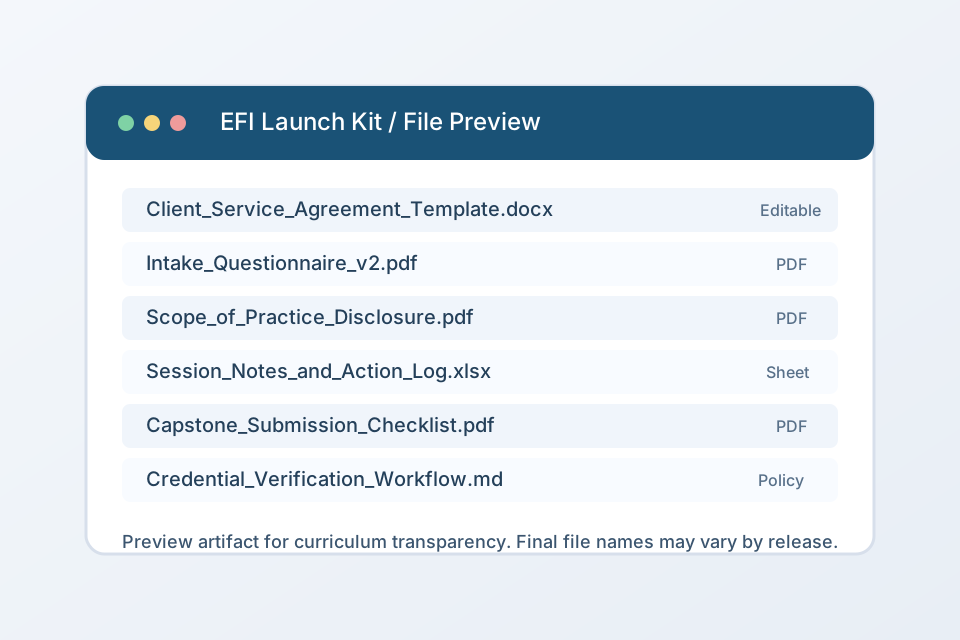
Launch Kit folder preview showing contract, intake, scope, rubric, and dashboard files
Representative file stack used in the asynchronous certification workflow.

Sample File Inventory

  • Client_Service_Agreement_Template.docx
  • Intake_Questionnaire_v2.pdf
  • Scope_of_Practice_Disclosure.pdf
  • Session_Notes_and_Action_Log.xlsx
  • Capstone_Submission_Checklist.pdf
  • Credential_Verification_Workflow.md

The curriculum is free to study. Paid services cover rubric scoring, formal feedback, credential operations, and alumni listing support.

Reference

Theoretical Models at a Glance

A comparative analysis of the three core theoretical models integrated throughout the curriculum.

Dimension Barkley Model Brown Model Dawson & Guare Model
Core Concept EF as unified self-regulation; Inhibition is the keystone Six integrated clusters; symphony orchestra metaphor 12 discrete skills in Thinking & Doing domains
Structure Hierarchical (Inhibition → 4 dependent functions) Cluster-based (6 interconnected clusters) Skills-based (12 independent skills)
Best For Understanding the mechanism of deficits Explaining situational variability Assessment and goal-setting
Key Insight "Time blindness" and the Extended Phenotype EF is chemically modulated, not willful "Goodness of Fit" between demands and skills
Coaching Application Justify prosthetic tools as medical supports Reduce shame by explaining variability Create targeted intervention plans

Choose Your Path

Read every module for free, or enroll in the CEFC certification track to get capstone review, competency verification, and a credential you can share with referral partners.