ADHD Coaching for Adults · Online & San Diego
ADHD coaching for adults who know what to do and still can’t start.
One-to-one executive function coaching for the gap between knowing and doing. We pick one real problem, build a system small enough to survive a bad week, and test it in your actual life.
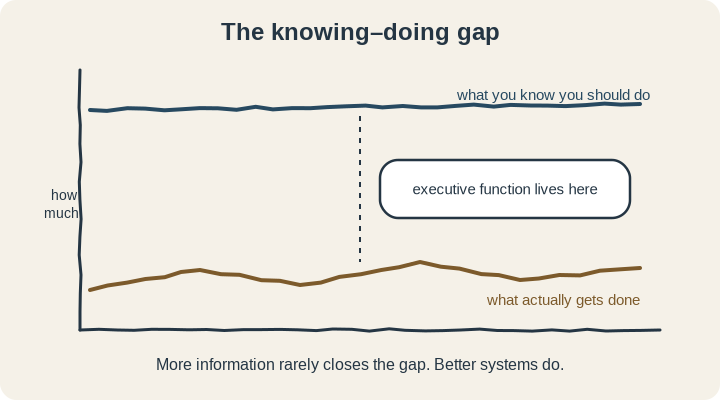
You know what to do. Starting is the hard part.
Most adults who book a call have already read the books and tried the apps. The problem was never information.
The important thing sits there
The email, the form, the project you care about. You think about it all day and still don’t open it.
Time keeps disappearing
Five minutes turns into forty. You are late to things you wanted to be at, and deadlines arrive without warning.
You run on panic
Nothing moves until it’s urgent. It works, but it costs you your evenings and your nerves.
Systems last two weeks
A new planner or app feels great, then quietly stops. You have a drawer of them.
Small admin piles up
Bills, appointments, renewals, the inbox. None of it is hard, and all of it is overdue.
You got diagnosed as an adult
Or you suspect ADHD. Either way you are rethinking years of “why can’t I just do it?”
Skills, not willpower.
ADHD mostly affects executive function: the brain’s system for starting, planning, tracking time, and following through. Coaching builds supports for those skills where you use them.
Getting started
Making the first step small and obvious enough that you take it. Related reading: ADHD paralysis.
Time
Seeing time, estimating it, and planning a day that fits the hours it has. Try the time blindness calibrator.
Follow-through
Finishing the last 20%, and picking things back up after a bad week instead of dropping them.
Planning and priorities
One trusted place for tasks and dates, and a way to choose what matters today.
Work and home admin
Email, paperwork, money tasks, and the routines that keep a household running.
The feelings around the work
Dread, shame, and overwhelm are often what blocks the start. We plan for them instead of pretending they aren’t there.
Start with four sessions and one problem.
The Beta Sprint is the starting point for new clients. Sessions are weekly, one hour, by video. In person is available in North County San Diego.
- 1
Friction map
We pick the one problem that is costing you the most right now and define what “better” would look like in four weeks.
- 2
System build
We design one small system for that problem, plus a fallback for the days it doesn’t work.
- 3
Real-life test
You run it for a week. We look at what happened without the moral commentary, and fix the design.
- 4
Keep or change
You decide what stays, what goes, and whether more coaching is useful. No pressure either way.
Rates are discussed on the fit call. Longer packages are available after the sprint: see coaching packages or the Beta Sprint details.
What coaching is, and what it isn’t.
Coaching is
- Practical work on starting, planning, time, and follow-through
- One system at a time, tested against your real week
- A weekly check-in with someone who knows how ADHD affects doing
- Led by your goals, at your pace
Coaching is not
- Therapy, diagnosis, or medical treatment
- Advice about medication
- A replacement for mental health care when that is what you need
- A productivity lecture
If something outside coaching comes up, I’ll say so and point you to the right kind of help. See the scope of practice.
You work with one person.

Jacob Rozansky
ADDCA-trained ADHD coach · High school special educator
I teach high school special education by day, so I spend my working life helping people whose brains don’t fit the default system. ExEF is my solo coaching practice for adults dealing with the same gap: knowing what to do and not being able to start.
I completed ADDCA’s ADHD coach training, and I’m now logging the coaching hours that certification requires. That is why the first clients get the Beta Sprint: a short, focused format while I build those hours.
Start with something free.
These take a few minutes and give you a clearer picture of where things break down.
Executive function test (EF Self-Check)
A 30-question self-check across five executive function areas.
Free toolTask start friction check
Rate what blocks you from starting and get a quick-start plan.
ArticleWhat is ADHD coaching?
What a coach does, what the research says, and how to pick one.
Questions people ask before booking
Do I need an ADHD diagnosis to work with a coach?
No. Coaching works on executive function skills like starting, planning, and follow-through. It helps whether you have a diagnosis, suspect ADHD, or just recognize the pattern. Coaching does not diagnose. If you want an evaluation, that is a job for a licensed clinician.
Is ADHD coaching the same as therapy?
No. Therapy is clinical care for mental health conditions. Coaching is practical, skills-based work on how you get things done. Many people use both. If something comes up that belongs in therapy, I will say so. There is a longer comparison in ADHD coach vs. therapist.
Are sessions online?
Yes. Sessions are one hour by video, so you can work with me from anywhere in the U.S. In-person sessions are available in North County San Diego.
How much does it cost?
Rates are discussed on the free 30-minute fit call, once we both know what the work is. New clients start with the four-session Beta Sprint. Sliding-scale seats open each quarter, so ask on the call.
Is Jacob a certified ADHD coach?
Not yet, and I want to be clear about that. I completed ADDCA’s ADHD coach training. Certification also requires a set number of coaching hours, and I am logging those now.
How long until I see a difference?
The sprint is built so you leave the second session with one system to try that week. Bigger changes take longer, and some weeks will go badly. That is expected, and it is what the weekly review is for.
What if coaching is not the right fit?
Then I will tell you on the fit call. Sometimes a free tool, a therapist, or a different kind of specialist is the better next step, and I would rather tell you that than sell you a package.
The next step is a 30-minute call.
Free, by video, no commitment. We talk through what is getting in the way and whether coaching is the right next move.